Focusing on pulp molding equipment for over 25 years.
Language
Focusing on pulp molding equipment for over 25 years.
Molding equipment is the main production equipment for pulp molded products. At present, it is common to use 4. molding machines to produce pulp molded lining cushioning (shockproof) packaging products. Commonly used ones include reciprocating molding machines and flip-type molding machines. Its characteristics include simple equipment operation and maintenance, low investment cost, flexible mold installation and replacement, and the ability to produce products with large size and high depth. The reciprocating molding machine is driven by a ventilated cylinder to lower the lower template (where the molding mold is installed) into the slurry tank to suck slurry. After the slurry suction is completed, it rises to the mid-stop position for dehydration. After dehydration is completed, it rises to the upper limit to complete closing. After molding and transferring the product, the wet paper mold is finally brought out from the upper template and blown down to the material receiving platform or drying line. The entire production cycle is about 3 to 4 times/min. Because the template area is large, larger molds can be installed. It is suitable for the production of industrial buffer packaging products with long suction filtration time, large product size, thick wall and complex shape. The flip-type molding machine uses a motor or pneumatic/hydraulic power to flip the lower template 180° into the slurry tank to suck slurry, then flip it back to the starting position for dehydration, and then lower the upper template to complete mold closing and product transfer. The upper template carries the wet paper mold The billet rises and blows down to the material receiving platform or drying line. The entire production cycle is about 3 to 4 times/min. The flip-type molding machine is similar to the reciprocating molding machine. It can effectively prevent "pocketing" and is suitable for the production of industrial buffer material products with small batches, long suction and filtration time, thick walls and complex shapes.
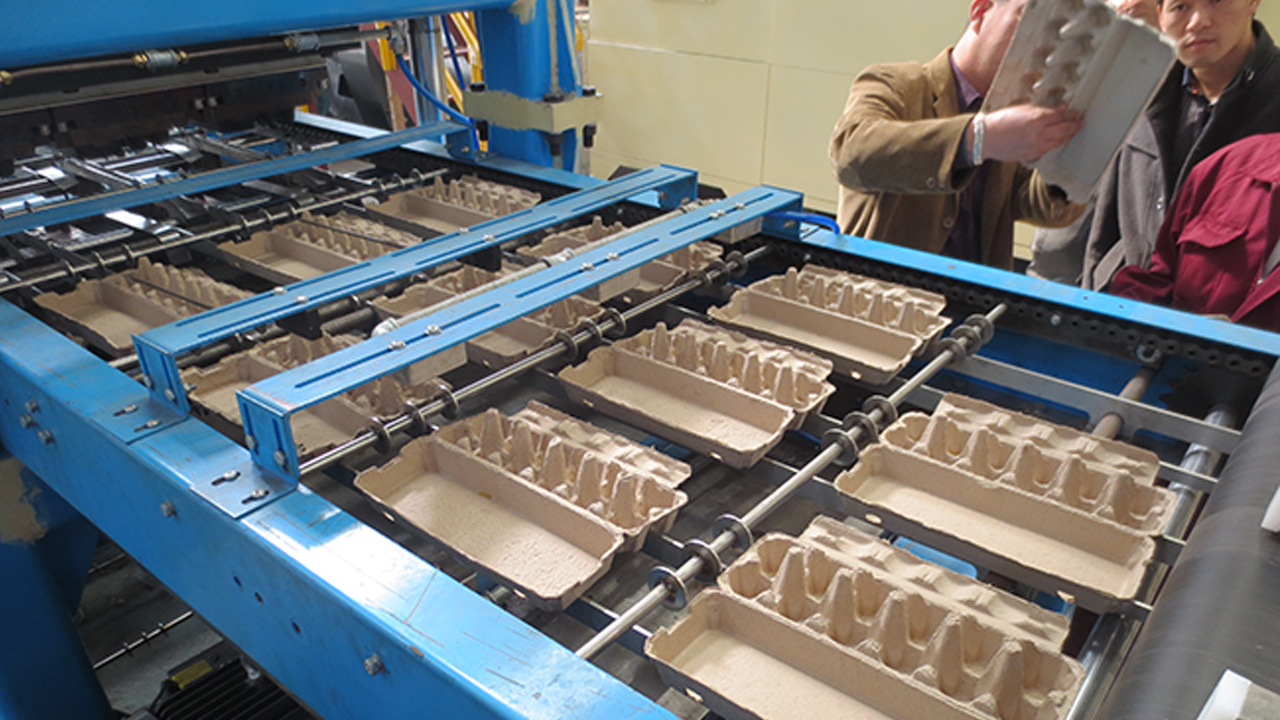
Currently, drum molding machines (using eight, six, or four stations) are used in the production of pallet products. They are characterized by high production efficiency, large production capacity, and a production cycle of about 15 to 20 times/ point. It is suitable for the production of pulp molded products with simple shapes and shallow depths, but requires high manufacturing precision of equipment, a large number of molds, and large investment. The rotating part of the drum adopts a pressing wheel-type intermittent mechanism. The drum is divided into eight/four-sided cylinders. It cooperates with the electric and pneumatic linkage to realize the continuous operation of the machine, electricity and pneumatic, so that the mold can complete pulp suction, dehydration and processing on the cylinder. Processes such as molding, shedding and cleaning of molds. It can realize continuous automated production of the entire process of molding paper molding products, and can adjust the speed of the eight-sided drum according to different products, adjust the time of pulp suction, and control the weight of the product. At present, this kind of equipment is commonly used in China to produce fruit trays, egg trays, egg boxes, bottle holders, coffee cup holders and other products.
Taking into account the production volume of the product, the scale of the factory and the production conditions, as well as the accuracy and wall thickness of the product, this production line uses a reciprocating double-cylinder double-station reciprocating forming machine. This kind of molding machine is generally semi-automatic, requires human operation, and has great flexibility. Its main parts include upper and lower templates (molds), tank frames and control devices. When the paper mold is formed, the tank of the molding machine is filled with slurry with a certain liquid level. The lower template and the forming mold are driven by the cylinder to sink into the slurry tank. The forming mold is connected to the vacuum system to make them suspended in the slurry. The fibers are adsorbed on its surface and formed. Then the lower template moves up to the middle position and continues to use vacuum dehydration. After reaching a certain dryness, it moves upward to fit the transfer mold on the upper template. At this time, the forming mold is converted into compressed air, and the transfer mold is connected to the vacuum to make the wet paper The mold is transferred. Finally, the upper template and mold are pushed forward by the transverse cylinder to the top of the conveyor belt, and are blown down by the action of compressed air and sent to the drying section. The slurry tank structure of the molding machine is an overflow type. The slurry concentration in the tank is always maintained at 1%, and the overflow amount is about 10%. The up-and-down movable molding machine has a simple structure and a small number of supporting molds. It can produce different pulp molded products by changing the molds at any time. It is especially suitable for the production of special industrial packaging products.
Besure Technology was founded in 1997 and is committed to providing one-stop eco-friendly pulp molding equipment solutions.
 +86 18823150295
 No.5 Yongye Road, Zone A Southwest
Industrial Park, Sanshui District, Foshan, China


Copyright © 2026 BeSure Technology Co., Ltd. - www.mybesure.com All Rights Reserved.粤ICP备2025367321号