Focusing on pulp molding equipment for over 25 years.
Language
Focusing on pulp molding equipment for over 25 years.
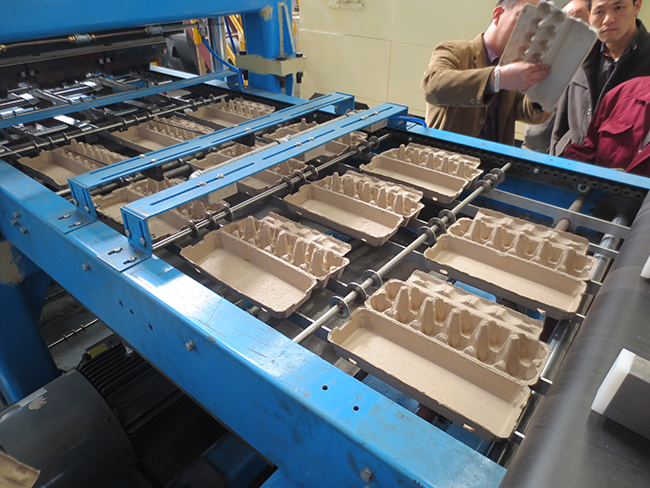
Pulp molding production process is a process of processing pulp products into products with specific shapes and structures through molds. The following are the steps of the general pulp molding production process:
1. Pulp preparation: First, pulp needs to be prepared, usually using waste paper or cellulose raw materials for pulping. This can be done with a pulp paper machine or other pulp preparation equipment.
2. Pulp adjustment: In order to obtain the pulp properties suitable for molding, the pulp needs to be adjusted. This includes adding chemicals to change the viscosity, fluidity and other physical properties of the pulp.
3. Mold preparation: According to the design requirements of the product, select the appropriate mold for molding. Molds can be metal, plastic, or other materials of the desired shape and size.
4. Pulp injection: inject the adjusted pulp into the mold. The pulp can be injected into the mold using an injection device or other methods, ensuring that the pulp fills every detail of the mold.
5. Molding: The pulp is molded in a mold for a certain period of time. This can be through heat, pressure or other treatments to promote the setting and curing of the pulp.
6. Demoulding: When the pulp is completely solidified, the mold can be opened, and the shaped pulp product can be taken out of the mold. This may require some auxiliary measures, such as vibration, shock or heat, to ensure a smooth release of the product from the mold.
7. Post-processing: Pulp products after demoulding may need some post-processing processes, such as trimming edges, polishing surfaces, coating protective layers, etc., to improve the quality and appearance of the product.
8. Inspection and packaging: Finally, the quality inspection of the finished product is carried out to ensure that the product meets the design requirements and specifications. Products are then packaged and labeled for storage, shipping and sale.
It should be noted that the specific steps and details of the pulp molding production process may vary due to product types, production scales and equipment differences. The above steps are for general reference only, and there may be specific adjustments and changes in actual production.

What are dry pressing and wet pressing? Where is the difference?
Dry pressing production and wet pressing production are two different pulp molding production process methods, and they have some differences in the processing of pulp and molding process.
1. Dry Pressing:
- Dry pressing is a method in which dry pulp is shaped by high-pressure mechanical force.
- First, the pulp is prepared through the pulping process and after conditioning the pulp is formed into a dry pulp sheet.
- Then, the dry pulp sheet is placed in a mold and shaped with high pressure.
- No moisture is involved in this molding process, hence the name dry pressing production.
- Dry pressing production is usually used to manufacture pulp products that require higher density and hardness, such as ceramic moulds, bricks, refractory materials, etc.
2. Wet Pressing:
- Wet pressing is a method of forming wet pulp through pressure and moisture control.
- First, the pulp is prepared through the pulping process and forms a wet pulp after pulp conditioning.
- Then, the wet pulp is injected into the mold and pressure is applied to shape it.
- During the forming process, by controlling the pressure and the discharge of moisture, the moisture in the pulp is gradually removed, so that the pulp can be formed into the desired shape in the mold.
- This molding process requires the presence of a certain amount of moisture, so it is called wet pressing production.
- Wet pressing production is usually used to manufacture pulp products that require lower density and softness, such as cardboard, cartons, paper bowls, etc.
The difference:
- Moisture content: In dry pressing the pulp is dry whereas in wet pressing the pulp is wet.
- Forming method: dry press production is formed by mechanical force, while wet press production is formed by moisture control and pressure.
- Applicable products: dry pressing is suitable for products with high density and hardness requirements, and wet pressing is suitable for products with low density and softness requirements.
- Process characteristics: dry pressing production does not need to involve water, the forming speed is relatively fast, but the plasticity of pulp is poor; wet pressing production needs to control the moisture content and drainage process, the forming speed is relatively slow, but the plasticity of pulp is good, can be Achieve more complex shapes and details.
- Cost and energy consumption: Dry press production generally requires higher pressure and mechanical force, while wet press production requires more moisture control and drainage processes. Therefore, there may be differences between the two methods in terms of cost and energy consumption.
- Product Quality: Since no moisture is involved in dry pressing production, the forming process is relatively fast and may result in a rough or uneven surface. A smoother and more uniform surface can be achieved by moisture control and drainage in wet pressing.
It is necessary to select a suitable production method according to specific product requirements and process conditions. Some products may be better suited to dry pressing, while others may be better suited to wet pressing. In addition, the two methods can also be used in combination, and dry pressing or wet pressing can be used in different production stages according to needs.
Besure Technology was founded in 1997 and is committed to providing one-stop eco-friendly pulp molding equipment solutions.
 +86 18823150295
 No.5 Yongye Road, Zone A Southwest
Industrial Park, Sanshui District, Foshan, China


Copyright © 2026 BeSure Technology Co., Ltd. - www.mybesure.com All Rights Reserved.粤ICP备2025367321号